Dehydrated vs Dry Skin: What Dermatology Sources Say
The short answer: The medical sources don't split them neatly: the AAD says excessively dry skin is noticeably dehydrated[1], and DermNet describes dry skin as low in both water and lipids[2]. The 'skin type vs condition' split comes from health sites such as Medical News Today[3]. Either way, pair a humectant with an occlusive[4], and don't count on extra water: the evidence is weak[6].
Heat check
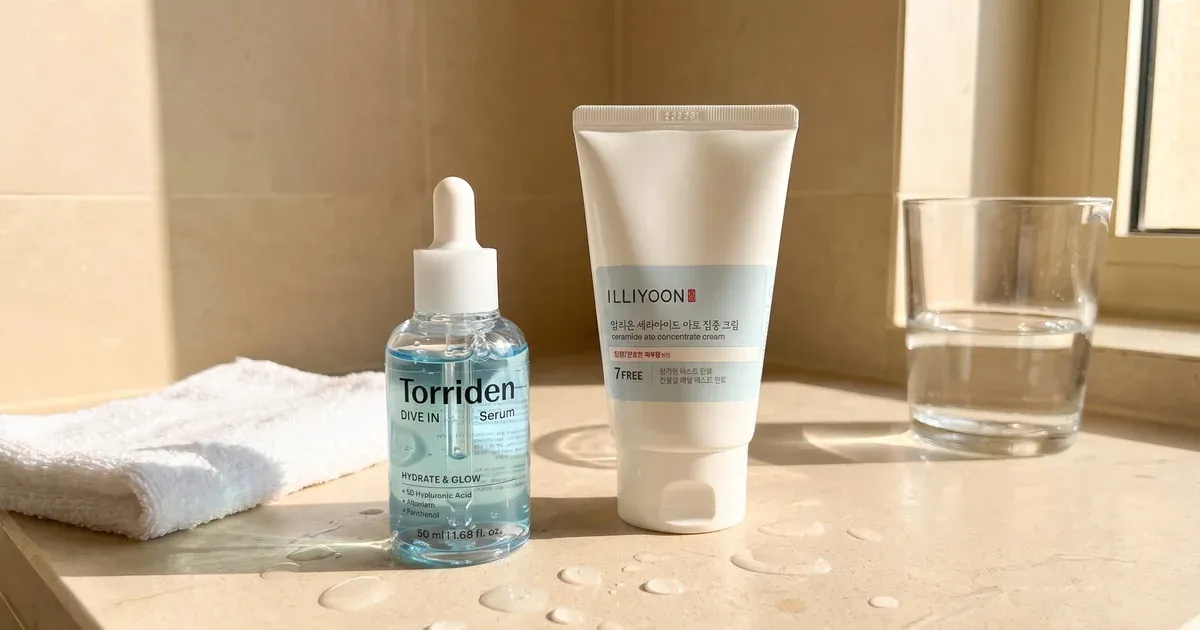
Some products pictured on this page are shown for illustration only and aren’t covered in this article.
Your skin feels tight after a day between the heat outside and the air conditioning inside. It looks a little dull, it feels rough around the nose, and somewhere online you read that it is not dry skin at all, it is “dehydrated skin”, and it needs different products.
So which is it, and does the label change what you should do? This guide puts together what dermatology and health sources say: the AAD, DermNet, Cleveland Clinic, Medical News Today and two studies on drinking water, with each source numbered at the end. It is general information, not a diagnosis, and it names no product.
Is dehydrated skin different from dry skin?
The split you see most often goes like this: dehydrated skin is a condition, skin that turns dry because it lacks water, while dry skin is a skin type, skin that lacks oil. That is how Medical News Today puts it[3].
The dermatology sources we read don’t draw the line so cleanly. The AAD says that excessively dry skin has lost a lot of moisture, so it is noticeably dehydrated[1]. In other words, very dry skin and dehydrated skin describe the same skin. DermNet, a dermatology reference, defines dry skin as skin that lacks moisture in its outer layer, the stratum corneum[2]. It adds that dry skin also has fewer lipids in that layer, which leaves it less able to hold on to water[2].
So in these sources, dry skin is short of both water and lipids at once. Calling it “dry” or “dehydrated” is mostly a question of wording. What matters more is how your skin feels and what you put on it.
What are the signs of dry or dehydrated skin?
The AAD lists the signs of dehydrated skin as dryness, fine lines that look more noticeable, and itch[1]. When skin loses enough moisture, it starts to flake off, and that is what makes it feel rough[1]. As it dries out further, it shrinks and cracks, and some cracks can become deep and bleed[1].
Where you live plays a part. DermNet names these environmental causes of dry skin[2]:
- Low humidity, as in desert climates or cool, windy weather.
- Excessive air conditioning.
- Direct heat from a fire or a fan heater.
If you spend the day moving between dry, hot air outside and a cold office inside, you get two of those at once. We cover the office side in more detail in our guide to air conditioning and dry skin.
Humectant or occlusive: which one do you need?
You don’t have to pick one. Cleveland Clinic explains that the two kinds of ingredient do different jobs and work together[4]:
- Humectants hydrate your skin by drawing water up from the deeper layer of skin, the dermis. Examples: hyaluronic acid, lactic acid, urea and sorbitol[4].
- Occlusives work in tandem with humectants. They stop moisture escaping, so your skin stays hydrated for longer. Examples: dimethicone, lanolin and petrolatum[4].
Timing helps too. Cleveland Clinic advises applying your moisturiser within three minutes, to help trap the moisture on your skin[4]. DermNet says the same in its own words: moisturisers (emollients) usually work best on damp skin, and when they contain humectants such as urea or propylene glycol[2].
In practice, that means a humectant layer on damp skin, sealed in with something occlusive on top, whichever name you give your skin.
Does drinking more water help dry skin?
Less than you might hope, based on the research we found.
In one study, 49 healthy women added approximately 2 L of water a day to their usual diet for 30 days[5]. The authors concluded that drinking more water might have a positive effect on normal skin, in particular for people who usually drink little[5].
A systematic review, which pulls together all the studies it can find on a question, came to a more cautious view[6]. Its search found 216 records; 23 articles were read in full and six were included. The authors call the evidence weak, in both the number of studies and their quality[6]. Extra water may increase hydration in the outer layer of skin, but how that would work is unknown, and research is still needed to show whether drinking more actually reduces the signs of dry skin[6].
Drinking enough water is good for you anyway. Just don’t expect it to fix tight, flaky skin on its own. Moisturising is what the medical sources above recommend.
When should you see a dermatologist?
The AAD separates everyday dry skin from excessively dry skin, which can need a dermatologist’s help[1]. Excessively dry skin has breaks in its outer layer, and germs can get in through them and cause an infection[1].
The AAD lists these signs of an infection[1]:
- Yellow crusts on the skin.
- An area of skin that leaks pus or other fluid.
- Swelling and discoloration.
If you see any of those, or your skin cracks and bleeds, see a doctor or dermatologist rather than switching moisturisers.
Skip it if your skin is cracked and bleeding, or shows yellow crusts, pus or swelling: the AAD says excessively dry skin can need a dermatologist, and lists those as signs of infection[1].
Sources
- [1]Dry skin: Signs and symptoms, American Academy of Dermatology (read )
- [2]Dry Skin (Xeroderma): Causes, Treatments, and More, DermNet (read )
- [3]Dehydrated vs. dry skin: Differences and more, Medical News Today (read )
- [4]The Best Moisturizer for Your Dry Skin? Here's What To Look For and How To Use It, Cleveland Clinic (read )
- [5]Dietary water affects human skin hydration and biomechanics (Clinical, Cosmetic and Investigational Dermatology, 2015), PubMed Central (read )
- [6]Does dietary fluid intake affect skin hydration in healthy humans? A systematic literature review (Skin Research and Technology, 2018), PubMed (read )
Same problem, other reads
- Three Hydrating Ampoules for Air-Conditioned Skin, Compared
WELLAGE Blue 100, Torriden Dive-In or SKIN1004 Probio-Cica for skin dried out by heat and air conditioning? Base, feel, reviews and prices.
- Mixing Serums in Summer Without Stinging
How to layer serums: lightest first, one at a time if skin stings, and which acid pairs irritate. From AAD, Cleveland Clinic and Harvard Health.
- Tight, Flaky Skin From Air Conditioning: What Helps
Air con pulls moisture out of indoor air, and skin dries below 30% humidity. What dermatologists advise, which ingredients to pick, and humidifiers.