Packing a Skincare Bag for a Beach Weekend
The short answer: Pack a broad-spectrum, water-resistant sunscreen with SPF 30 or higher, a lip balm with SPF 30 or more[1], plus a wide-brimmed hat and sunglasses with UV protection[2]. Most adults need about 1 ounce of sunscreen to cover exposed skin[1], and it needs reapplying every two hours and right after swimming[1]. Keep the bottle wrapped in a towel or in the shade[4].
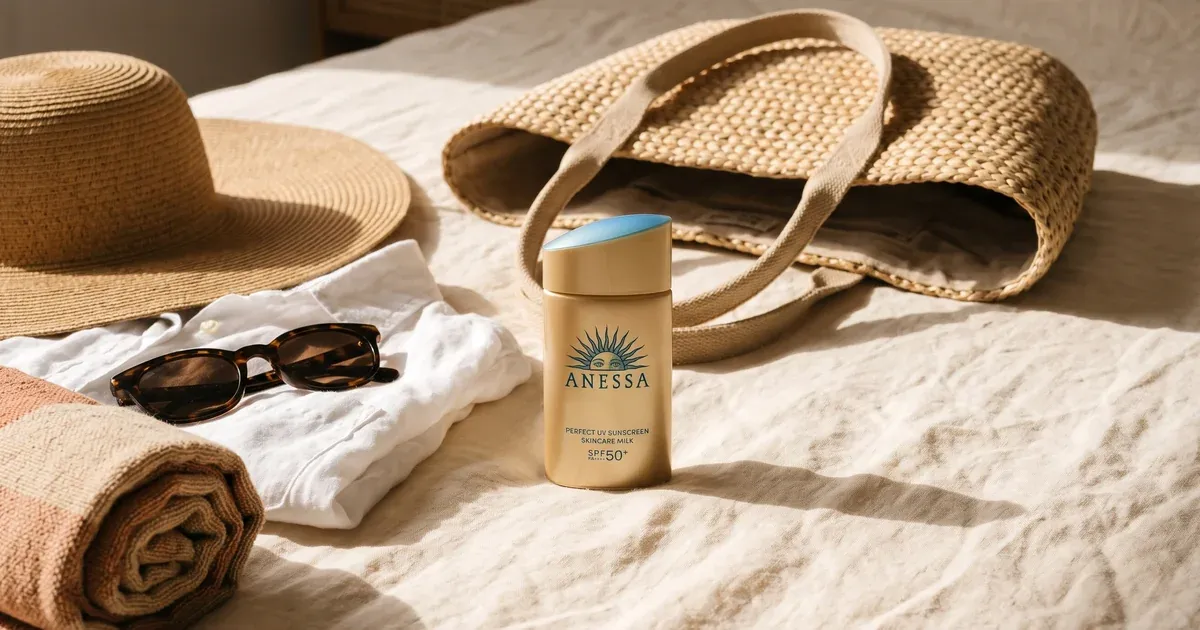
Some products pictured on this page are shown for illustration only and aren’t covered in this article.
A weekend at the beach means a small bag, a lot of sun and very little shade. The aim is to pack light without leaving out the things that keep you from burning.
This guide pulls together what two health bodies say: the American Academy of Dermatology (AAD) and the FDA, with each source numbered at the end. It is general advice, not a diagnosis, and it names no product or medicine.
What goes in a beach weekend skincare bag?
The AAD’s list for the sunscreen itself is short: choose one with SPF 30 or higher that is water resistant and gives broad-spectrum (UVA and UVB) coverage[1].
What else earns a place in the bag:
- A lip balm with an SPF of at least 30[1].
- A wide-brimmed hat and sunglasses with UV protection[2].
- A lightweight, long-sleeved shirt for the hours you are not in the water[2]. Clothing with an ultraviolet protection factor (UPF) label gives more effective protection, the AAD says[2].
How much sunscreen should you pack?
More than most people think. At a minimum, most adults need about 1 ounce of sunscreen, roughly the amount to fill a shot glass, to fully cover skin not covered by clothing, and you may need more depending on your body size[1]. For the face alone, the AAD says to use at least 1 teaspoon[1].
You need that amount every time you reapply, not once a day. So pack a full bottle rather than a travel sample, and check how much is left before the second day.
Why does the beach call for extra care?
The AAD says to use extra caution near water, snow and sand, because they reflect the damaging rays of the sun, which can increase your chance of sunburn[2]. A beach has two of the three.
Timing matters too. The sun’s rays are strongest between 10 a.m. and 2 p.m., and the AAD’s rule of thumb is simple: if your shadow is shorter than you are, seek shade[2].
How often should you reapply at the beach?
Start before you reach the sand: the FDA says to apply sunscreen 15 minutes before sun exposure[4].
Once you are out, the AAD says to reapply every two hours, and immediately after swimming or sweating[1]. The FDA gives the same advice: at least every two hours, and more often if you are swimming or sweating[4].
“Water resistant” does not mean it stays on all day. According to the FDA, no sunscreen is “waterproof”, and a water-resistant label must say whether it stays effective for 40 minutes or 80 minutes when swimming or sweating[4]. The AAD adds that no sunscreen is “sweatproof” either, so reapply after a swim or a sweaty walk[3]. For what to do after a hot, sweaty day, see caring for your skin after sweating outdoors.
How do you keep sunscreen working in the heat?
Heat is hard on the bottle as well as on you. The FDA recommends not exposing sunscreen containers to direct sun, and wrapping them in towels or keeping them in the shade when you are outside in the heat for long periods[4].
Check the date before you pack. The FDA says not to use sunscreen that has passed its expiration date, and a sunscreen with no expiration date should be considered expired three years after purchase[4].
What if you get sunburned anyway?
The first thing to do is get out of the sun, preferably indoors[5]. Then, from the AAD[5]:
- Take frequent cool baths or showers to help relieve the pain, and gently pat yourself dry afterwards.
- Apply a moisturizer that contains aloe vera or soy while your skin is still damp, and whenever you feel discomfort.
- Drink extra water. A sunburn draws fluid to the skin’s surface and away from the rest of the body, and extra water helps prevent dehydration.
- If your skin blisters, that is a second-degree sunburn. Do not pop the blisters; keep them clean and apply petroleum jelly while they heal.
At the end of the day, the sunscreen still has to come off. See whether one cleanser is enough to remove sunscreen.
What this guide does not cover
This guide repeats general advice from the AAD and the FDA, numbered below. It does not pick a product, it does not diagnose anything, and it does not replace a doctor.
If a sunburn is severe, or it does not get better, speak to a doctor rather than relying on this page.
Skip it if you want a product pick or a diagnosis: this guide only repeats general advice from the AAD and the FDA, and names no product or medicine.
Sources
- [1]How to apply sunscreen, American Academy of Dermatology (read )
- [2]How to prevent skin cancer, American Academy of Dermatology (read )
- [3]Sunscreen FAQs, American Academy of Dermatology (read )
- [4]Sunscreen: How to Help Protect Your Skin from the Sun, U.S. Food and Drug Administration (read )
- [5]How to treat sunburn, American Academy of Dermatology (read )
Same problem, other reads
- How to Protect Your Hair and Scalp From Strong Sun
What the AAD, the Skin Cancer Foundation and Cleveland Clinic say about sun and hair: which hat covers enough, sunscreen on a scalp, and hours to avoid.
- Makeup in Hot Weather: Sunscreen Before or After?
Where sunscreen goes in a hot-day makeup routine, how much to use, whether SPF foundation is enough, and what the AAD says about sweat and breakouts.
- Skincare After Sweating Outdoors: What to Do First
What health sources say to do after heavy sweating outdoors: wash gently, change clothes if you can't shower, soothe heat rash, reapply sunscreen.