Tight, Flaky Skin From Air Conditioning: What Helps
The short answer: Air conditioning removes moisture from the air[1]. In a small study at 25°C, eyes and skin became dry below 30% relative humidity[3]. Dermatologists advise moisturising while skin is still damp and several times a day, with a cream or ointment rather than a lotion[2].
Heat check
- Suits
- Skin that feels tight in cold office air. The example serum, Torriden Dive-In, is sold as suiting all skin types[4]
- In the heat
- Hot outside, dry inside: Torriden says it made this serum for people who dislike the sticky feel of hyaluronic acid[4]
- Price in the region
- Torriden Dive-In 50ml: US$19.50 delivered to Israel from Olive Young Global[4]
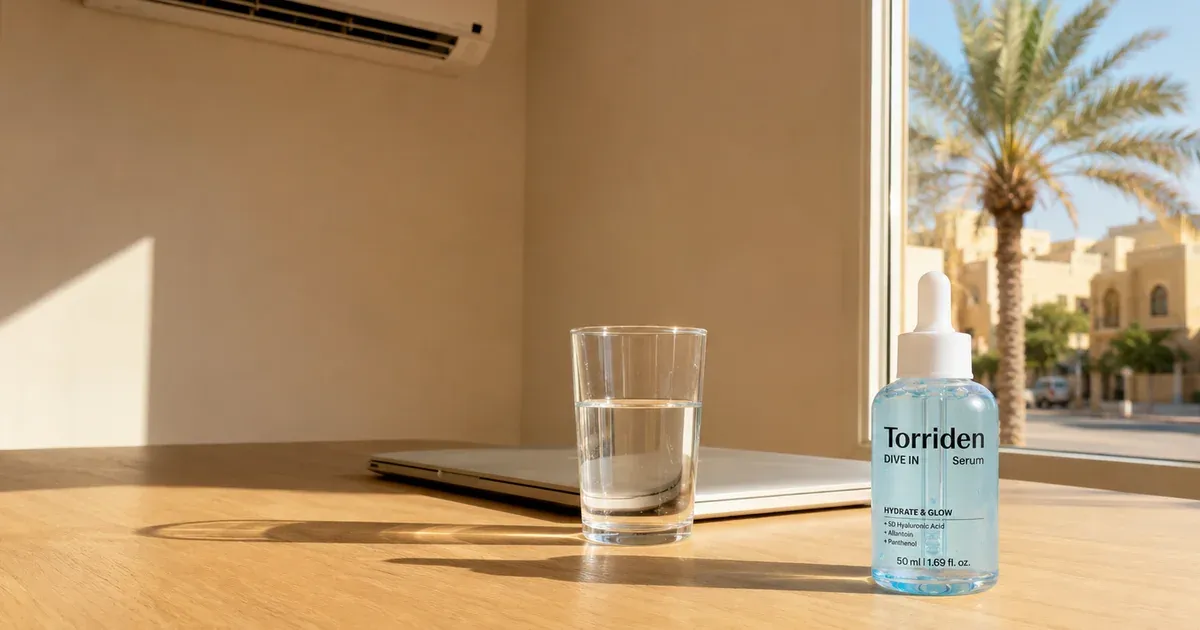
Outside it’s hot. Inside, the office air con runs all day. By mid-afternoon your face feels tight, and there are flaky patches around your nose or on your cheeks, even though you moisturised that morning. The short version: air conditioning takes moisture out of the air[1], skin dries out when indoor air gets dry enough[3], and dermatologists advise moisturising while skin is still damp and again whenever it feels dry[2]. This piece pulls together guidance from the US EPA, the AAD (the main US body for dermatologists) and one lab study, numbered at the end.
Why does air conditioning dry out your skin?
Drying the air is part of the job. The US EPA notes that one function of a building’s heating, ventilation and air conditioning system is to remove moisture from the air before it is blown through the building[1].
The tricky part is that you may not feel it happening. In a Japanese lab study, people felt cold straight away when the humidity changed, but only slightly noticed that the air had become drier[3]. That fits the familiar pattern: the room feels fine, and your skin only tells you hours later.
How dry does indoor air have to get before skin notices?
One study gives a rough line. Researchers kept a room at 25°C and set the relative humidity to 10%, 30% and 50%[3]. Below 30%, the eyes and skin became dry[3], and the authors concluded that relative humidity should stay above 30% to avoid that[3].
Read it as a reference point, not a hard rule for everyone. The study looked at sixteen healthy, non-smoking male students at a single temperature[3]. No women took part, and nothing was measured in a real office.
For comparison, the US EPA advises keeping indoor humidity below 60%, ideally between 30% and 50%[1]. The EPA’s concern there is mould, not skin, but the lower end of its range lines up with the study.
What do dermatologists advise for dry skin?
The AAD puts timing first:
- Keep showers short and warm. Five to ten minutes, with warm water[2].
- Moisturise several times a day. Right after a shower while skin is still damp, after washing your hands, and whenever your skin feels dry[2].
On an air-conditioned workday, that last point matters most. One layer in the morning is not what the AAD describes: keep a small tube at your desk and reapply when your skin starts to feel tight.
Which moisturiser ingredients should you look for?
Texture comes first. The AAD says ointments and creams add more moisture to skin and work better than lotions[2]. It suggests looking for a cream or ointment with one or more of these: jojoba oil, dimethicone, glycerin, hyaluronic acid, lactic acid, lanolin, mineral oil, petrolatum or shea butter[2].
What to drop matters too. If your skin is dry, the AAD advises stopping products that contain alcohol (hand sanitiser is the exception), fragrance, including deodorant soaps, or retinoids[2].
If a cream feels too heavy for the hot walk outside, a hydrating serum is a lighter first layer. Torriden Dive-In is one example: its ingredient list opens with water, butylene glycol and glycerin[4], and the brand says it contains five types of hyaluronic acid in different molecular sizes, plus panthenol and allantoin[4]. Torriden says it made the serum for people who need moisture but dislike the sticky feel of hyaluronic acid[4].
Be clear on what a serum is, though. The AAD’s advice is about creams and ointments, so a serum does not replace them once your skin is already flaking. Use it under a cream, not instead of one.
Do you need a humidifier?
At home, it can help. The AAD recommends a humidifier for dry skin: if you use a portable one, put it in your bedroom, run it while you sleep, and clean it regularly to prevent mould[2].
Don’t overdo it. The EPA advises keeping indoor humidity below 60%, ideally between 30% and 50%[1], because damp air brings its own mould problem.
At work you usually can’t change the humidity, so the reapplying habit above does most of the job there.
Skip it if you use products with alcohol, fragrance or retinoids: dermatologists advise people with dry skin to stop using them[2], so sort that out before blaming the air con.
Where to buy, by country
Some of these links earn Sunwise a commission.
Torriden Dive-In Low Molecular Hyaluronic Acid Serum (50ml)
| Country | Where | Price |
|---|---|---|
| Israel | Olive Young Global | US$19.50checked |
Prices move. Check the total at checkout before you pay.
Sources
- [1]Mold Course Chapter 2: Investigating, Evaluating, and Remediating Moisture and Mold Problems, US EPA (read )
- [2]Dermatologists' top tips for relieving dry skin, American Academy of Dermatology (read )
- [3]Physiological and Subjective Responses to Low Relative Humidity (Journal of Physiological Anthropology, 2006), J-STAGE (read )
- [4][Upgraded] Torriden Dive In Low Molecular Hyaluronic Acid Serum 50ml, Olive Young Global (read )
Same problem, other reads
- Dehydrated vs Dry Skin: What Dermatology Sources Say
Dry or dehydrated skin? What the AAD, DermNet and Cleveland Clinic say about the difference, which ingredients help, and whether drinking water does.
- Three Hydrating Ampoules for Air-Conditioned Skin, Compared
WELLAGE Blue 100, Torriden Dive-In or SKIN1004 Probio-Cica for skin dried out by heat and air conditioning? Base, feel, reviews and prices.
- Mixing Serums in Summer Without Stinging
How to layer serums: lightest first, one at a time if skin stings, and which acid pairs irritate. From AAD, Cleveland Clinic and Harvard Health.