On the Label: Hyaluronic Acid
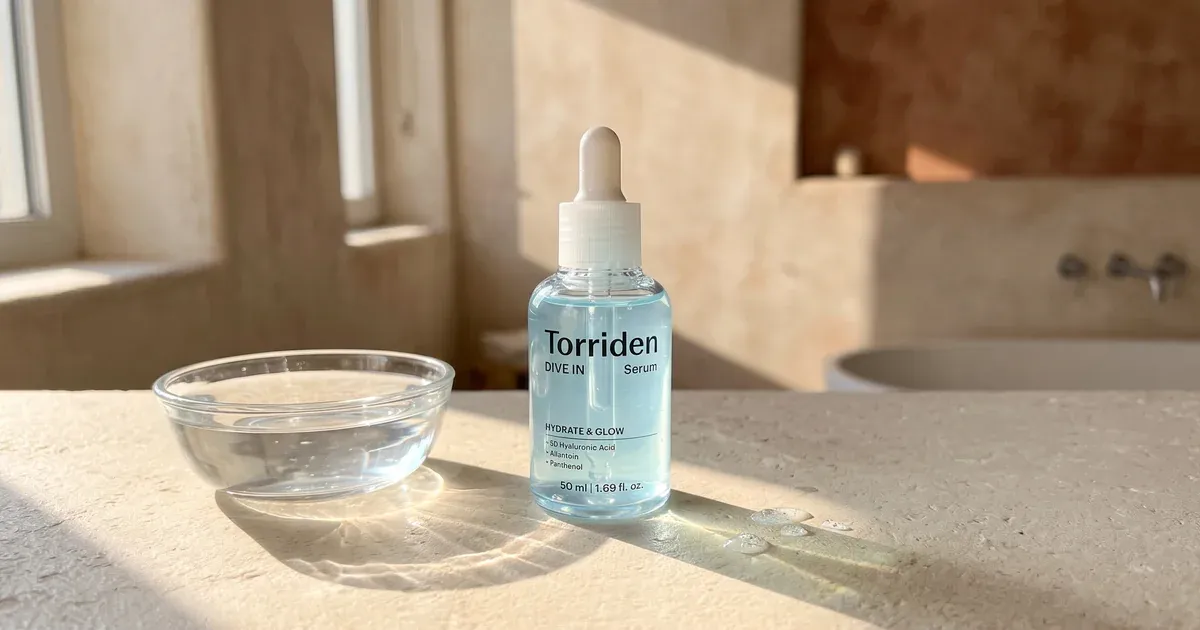
Hyaluronic acid. The key molecule behind skin moisture, with an unusual capacity to hold on to water. Young skin stays plump and springy largely because it holds so much of it[1]. On an ingredient list you may see hyaluronic acid, sodium hyaluronate or potassium hyaluronate, and it is mostly made by bacterial fermentation or taken from rooster combs[2]. In skincare it’s there to support your skin’s hydration, not to treat skin conditions. This entry pulls together published studies, a safety review and a medical guide, numbered at the end.
What does it do on your skin?
Hyaluronic acid is a humectant: it hydrates your skin by drawing water up from the dermis, the deeper layer of skin[3]. Occlusives such as dimethicone and petrolatum work alongside humectants, preventing moisture loss so your skin stays hydrated longer[3].
So in all-day air conditioning, a moisturiser over your hyaluronic serum helps keep that water in. More on dehydrated vs dry skin and air conditioning and dry skin.
Does molecule size matter?
“Low molecular” on a label means smaller molecules. In a study in Munich[4], seventy-six women aged 30 to 60 with wrinkles around the eyes applied a 0.1% hyaluronic acid cream (50, 130, 300, 800 or 2000 kDa) around one eye and a base cream without hyaluronic acid around the other, twice a day for 60 days, with sizes assigned at random. All five creams improved hydration and elasticity compared with the base. Only the 130 and 50 kDa groups showed less wrinkle depth after 60 days, which the authors suggest may be because smaller molecules penetrate better.
A double-blind, randomised trial in a Jakarta nursing home gave 36 people aged 60 to 80 with dry skin three lotions: low molecular, high molecular and a plain base, each on a different area of the leg, measured at weeks 0, 2 and 4[5]. After 4 weeks the low molecular area was better hydrated than the other two. There was no difference in water loss through the skin or in symptoms, and no side effects.
A review found hyaluronic acid below 100 kDa penetrates skin, with lower molecular weights reaching the dermis[6]. Its authors were employed by the company Givaudan France.
Both trials are small and short, one around the eyes, one on older legs. The results lean towards smaller molecules, but that isn’t settled.
Is it safe?
The expert panel of the Cosmetic Ingredient Review found hyaluronic acid was not toxic across a wide range of animal studies and was not a sensitiser in animals[2]. Widespread clinical use, mainly by injection, has been free of significant adverse reactions. The panel considers hyaluronic acid and its sodium and potassium salts safe in cosmetics, where they work as skin conditioners at up to 2%.
Still, try a new product on a small patch first. If your skin reacts, stop and see a dermatologist.
What does “multiple types of hyaluronic acid” on a label tell you?
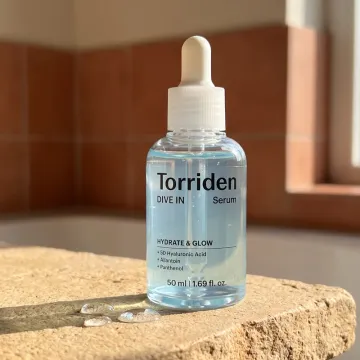
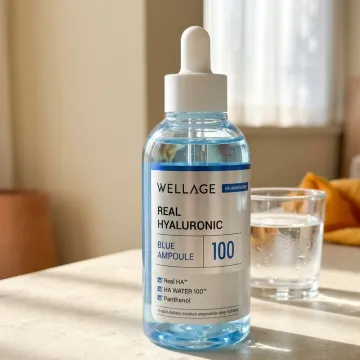
Less than it sounds. The Torriden Dive In product page lists five types: 3,000 kDa and 1,600 kDa high-weight molecules to form a moisture barrier, one 100 kDa medium-weight, and two 10 kDa low-weight, alongside panthenol and allantoin. WELLAGE says its Real Hyaluronic Blue 100 Ampoule uses a HY-AMINOSOME complex of 7 hyaluronic acids and 4 amino acids, plus Salmon PDRN and panthenol.
These are brand descriptions, not study results. A count of types doesn’t tell you how much is in the bottle, and you only know the sizes when a brand lists them in kDa, as Torriden does. For how the two compare in heat and air conditioning, see hydrating ampoules.
Where to buy, by country
Some of these links earn Sunwise a commission.
Torriden Dive In Low Molecular Hyaluronic Acid Serum (50ml)
| Country | Where | Price |
|---|---|---|
| Israel | Olive Young Global | US$26.00checked |
WELLAGE Real Hyaluronic Blue 100 Ampoule (2 x 75ml set)
| Country | Where | Price |
|---|---|---|
| Israel | Olive Young Global | US$35.84checked |
Prices move. Check the total at checkout before you pay.
Sources
- [1]Hyaluronic acid: A key molecule in skin aging, Dermato-Endocrinology (read )
- [2]Final report of the safety assessment of hyaluronic acid, potassium hyaluronate, and sodium hyaluronate, International Journal of Toxicology (read )
- [3]Choosing the Best Moisturizer for Dry Skin, Cleveland Clinic (read )
- [4]Efficacy of cream-based novel formulations of hyaluronic acid of different molecular weights in anti-wrinkle treatment, Journal of Drugs in Dermatology (read )
- [5]Effectiveness of topical hyaluronic acid of different molecular weights in xerosis cutis treatment in elderly: a double-blind, randomized controlled trial, Archives of Dermatological Research (read )
- [6]Hyaluronic Acid in Topical Applications: The Various Forms and Biological Effects of a Hero Molecule in the Cosmetics Industry, Biomolecules (read )