Asian vs European Sunscreen: What Actually Differs
The short answer: There is no secret Asian filter. A best-selling Korean sunscreen, Relief Sun, uses four UV filters that are all on the EU's approved list[6][7]. What differs is the base formula you feel on skin, and how the label grades UVA: PA+ to PA++++ in Japan and Korea[2], a UVA factor of at least 1/3 of the SPF in the EU[1].
Heat check
- Suits
- Skin that finds heavy sunscreen uncomfortable: Relief Sun's ingredient list opens with water, then rice extract[7]
- In the heat
- In strong sun the amount matters more than the origin: the label number assumes 2 mg/cm2, and using half can cut protection by as much as two-thirds[1]
- Price in the region
- Relief Sun 50mL: US$14.99 delivered to Israel from Olive Young Global[7]
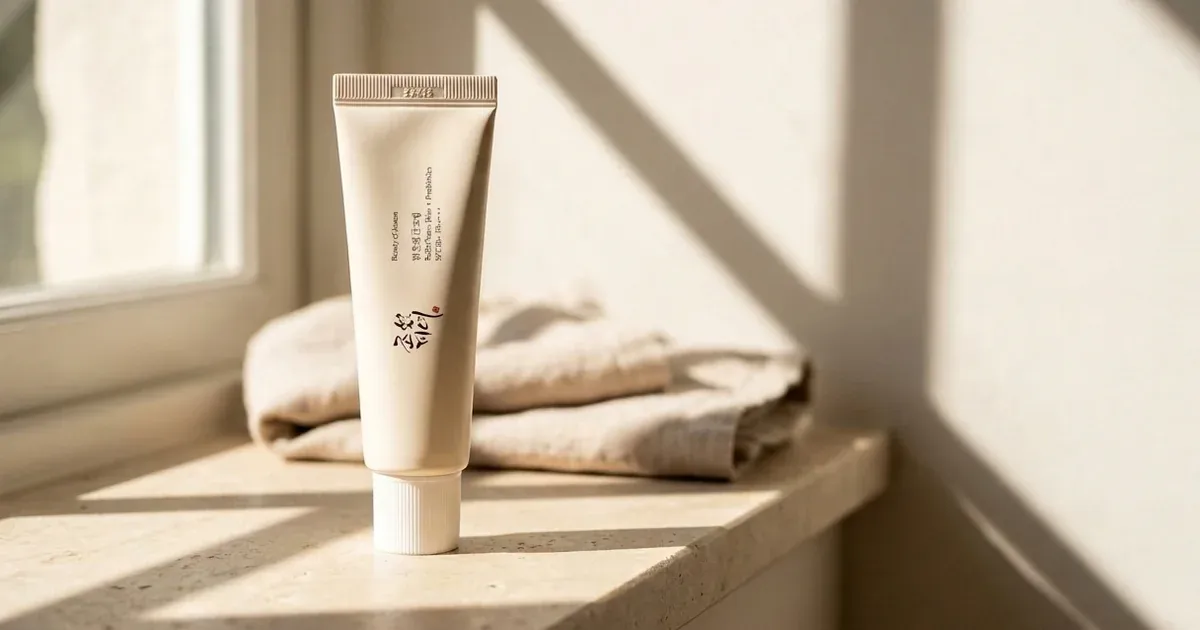
Korean and Japanese sunscreens have a reputation for feeling lighter than European ones, and you’ll often hear that Asia simply has better UV filters. Take Beauty of Joseon Relief Sun, a Korean bestseller: its label reads SPF50+ PA++++[8]. So what is actually different? Mostly the base formula around the filters, and the way each region grades UVA on the label. This piece pulls together the rules and product listings, numbered at the end.
Do Asian sunscreens use UV filters Europe doesn’t allow?
Not in the example people point to most. Relief Sun’s ingredient list names four UV filters: Diethylamino Hydroxybenzoyl Hexyl Benzoate, Ethylhexyl Triazone, Methylene Bis-Benzotriazolyl Tetramethylbutylphenol and Diethylhexyl Butamido Triazone[7].
All four appear on the EU’s list of UV filters allowed in cosmetics, Annex VI of the EU’s cosmetics law[6]. So this Korean favourite isn’t built on a filter Europe has never approved. That doesn’t make every Asian sunscreen the same as every European one, but the idea of a secret Asian filter doesn’t hold up here.
Why do Korean and Japanese sunscreens feel lighter?
If the filters can be the same ones Europe allows, the difference you feel has to come from the rest of the formula: the base that carries those filters.
Relief Sun’s ingredient list opens with water, followed by rice extract[7]. So when a sunscreen feels light, the filters are only part of the story; look at what it’s built on.
PA++++ or the EU UVA standard: how do they compare?
Both systems grade protection against UVA, but they show it in different ways.
Japan. Under the voluntary standards of the Japan Cosmetic Industry Association, PA grades follow the measured UVA protection factor (UVAPF): PA+ from 2 to under 4, PA++ from 4 to under 8, PA+++ from 8 to under 16, and PA++++ from 16 up[2]. A PA grade must always appear with an SPF. A product can only say SPF 50+ when the lower limit of the 95% confidence interval reaches 51.0[2].
Korea. Sunscreen counts as a functional cosmetic, which is regulated more strictly than ordinary cosmetics. The company has to submit data backing its SPF and PA grade, using recognised methods such as ISO 24444 and ISO 24442[3].
Europe. The EU recommends that UVA protection is at least 1/3 of the SPF on the label, with a critical wavelength of 370 nm[1]. It also recommends a minimum of SPF 6. The label “50+” is kept for products measured at SPF 60 or more[1].
So PA is a grade on its own scale, while the EU ties UVA to the SPF as a ratio. There is no official way to convert one into the other, so read each on its own terms.
Which UV filters has Europe restricted?
Europe keeps reviewing its list, and two familiar filters have been tightened.
Homosalate. It was allowed as a UV filter at up to 10% of the finished product[4]. It is now limited to face products (creams and pump sprays, not aerosols), with a lower ceiling than before[4].
4-MBC. It was allowed at up to 4%[5]. The EU has since removed it from the list of permitted UV filters: from 1 May 2025, products containing it can’t be placed on the EU market, and from 1 May 2026 they can’t be sold there at all[5].
These are changes to EU rules, and they apply inside the EU. A sunscreen made for another market may still contain these filters, so check the ingredient list if you’d rather follow the EU’s current list.
Buying in Israel or the Gulf: how do you read the label?
Shelves in Israel, the UAE and Saudi Arabia can carry both Asian and European sunscreens side by side, so you may see either labelling style. Three things to check:
- The SPF. The headline number on the front.
- The UVA rating. A PA grade on Asian products, or the EU UVA standard on European ones.
- How much you use. The number on the label assumes 2 mg/cm2 of skin, the amount used when it was measured. Use half that and protection can fall by as much as two-thirds[1].
The last point matters more than where the tube was made.
Skip it if you want a verdict that Asian sunscreen is simply better: the rules don't support one, and this piece compares labels and filters, not individual products.
Where to buy, by country
Some of these links earn Sunwise a commission.
Beauty of Joseon Relief Sun: Rice + Probiotics (50mL)
| Country | Where | Price |
|---|---|---|
| Israel | Olive Young Global | US$14.99checked |
Prices move. Check the total at checkout before you pay.
Sources
- [1]Commission Recommendation of 22 September 2006 on the efficacy of sunscreen products and the claims made relating thereto, EUR-Lex (read )
- [2]JCIA Standards and Related Notifications for Sun Protection Factor (SPF), UVA protection Grade (PA) and Water Resistance for UV Protection, Japan Cosmetic Industry Association (read )
- [3]South Korea Functional Cosmetic Regulation, ChemLinked (read )
- [4]Commission Regulation (EU) 2022/2195 amending Regulation (EC) No 1223/2009, EUR-Lex (read )
- [5]Commission Regulation (EU) 2024/996 amending Regulation (EC) No 1223/2009, EUR-Lex (read )
- [6]Regulation (EC) No 1223/2009 on cosmetic products, Annex VI: list of UV filters allowed in cosmetic products, EUR-Lex (read )
- [7]Beauty of Joseon Relief Sun: Rice + Probiotics 50mL, Olive Young Global (read )
- [8]Beauty of Joseon Relief Sun: Rice + Probiotics (SPF50+ PA++++) Double Pack, Olive Young Global (read )
Same problem, other reads
- Mineral vs Chemical Sunscreen: Which for Strong Sun?
Mineral or chemical sunscreen? What the AAD, Cleveland Clinic and the FDA say about how each works, safety, sensitive skin and hot, sweaty days.
- Cream or Serum? Relief Sun vs Hyalu-Cica Sun in Dry Heat
Relief Sun or SKIN1004 Hyalu-Cica Sun Serum for strong sun and dry heat? Same UV filters, different feel: what brands and reviewers say, plus prices.
- Your First Skincare Routine in Hot Weather
A three-step routine from the AAD: cleanse, moisturise, protect. Sources differ on SPF 15 or 30. We found nothing that changes the routine for heat.